08 September

Interview questions for experienced Physical Design Engineer, Question set - 9

 
Code: CDN4Y072021PD


Experience level: 4 Year
Profile: Physical Design Engineer

1. Introduction and physical design experience
2. What major differences have you observed in the 7nm and 14nm process nodes?
3. What is the functionality of this circuit? (He drawn schematic in paint)
4. Do you think, is there any issue with the above circuit? If so what would you suggest for improvement?
5. When clock gatting circuit has added in the design RTL/Synthesis/PnR?
6. What are the checks you perform before starting the floorplan?
7. What is a library check?
8. What are the information available inside the .lib file?
9. How is the timing of a cell defined in .lib file?
10. What if the .lib file is missing but .lef file is available for a cell? and similarly, if .lef file is missing but .lib file is present for a cell?


11. How do we define the core area for any block?
12. How do we decide the height and width of a block?
13. What are the guidelines we need to follow in macro placement?
14. Is there any rule for abutting the macros?
15. What steps exactly tool does in the placement stage?
16. Why do we use boundary cells?
17. Why can't we use placement blockage at the end of each row in place on the boundary cell?
18. What was the target latency in your block and what has been achieved?
19. Can you explain the ccopt method?
20. Which flavour of Vt cell you used in the clock tree?


21. Which type of derating you have been used in your different projects?
22. Why do we start using POCV when we had AOCV derate?
23. What is the shielding of a net? How it works?
24. Have you used shielding in your block?
25. What is NDR?
26. What is the difference between shielding and NDR? Can we use only one of these two?
27. Where did you placed the clock gating cell, near the sink or source?
28. Can you tell me the advantage and disadvantages of placing ICG near the sink and near the source?
29. What is CPPR?
30. (A diagram has been drawn in paint as shown below) In this diagram can you tell me between which edges the setup and hold timing will be checked?

31. If we change the scenario like below, Now between which edge setup and hold will be checked? 
32. What is internal power and switching power?
33. What is the impact of the threshold voltage of a cell on the internal power and switching power?
34. What is the impact of IR drop in cell delay?
35. How do you fix the static IR drop?
36. What was the limit of dynamic IR drop in your recent project?


28 August

Flip-flop and Latch : Internal structures and Functions

The flip flop is the most commonly used sequential element in any ASIC design, especially the D-type flip-flop. In the D flip flop, the D indicates delay, which means the output is a delayed version of input D.  Whereas a latch is the simplest and a basic sequential element. In general, there are two latches used to make a flip flop. the flip-flop is sensitive to clock edge and the latch is sensitive to clock level. The following section will explain the internal structure and operation of flip flops and latch. In this article, we will limit our discussion to only d type flip flops and d type latch which are most common in ASIC design. 


Schematic of the latch and flip-flop

The simplest design latch and flip-flop both are having 3 pins, One input data pin (D), one input clock/enable pin (CP/E) and, one output pin (Q). There could be a set and reset pins also but here for simplicity we are not including those in our discussion. The symbolic representation of a latch and a flip flop has been shown in figure-1.

Figure-1: Symbolic representation of Latch and flip-flop

In figure-1, the symbol of a posotive level sensitive d-latch and a positive edge triggered d flip-flop has shown. In negative latch and flip-flop only a dot appears before the E/CP pin. At a high level, we can think that latch and flip flop in terms of 2:1 multiplexer. A latch can be realized using a 2:1 multiplexer whereas to realize a flip flop, two multiplexers are required. Figure-2 showing the architecture of positive level sensitive d-latch and a positive edge triggered flip flop in terms of multiplexers.

Figure-2 : A positive d-latch and flip-flop using multiplexer

In a positive level sensitive latch the output is fed to I0 input of multiplexer as shown in figure-2. In same way in a negative level sensitive d-latch the output Q is fed back to input I1. A positive edge triggered d-flip flop is made of two negative level sensitive d-latch connected back to back. In case of negative d flip flop two positive level sensitive d-latch would be required. If we dive deep inside the multiplexer and go to the transistor level, we will find the transistor level schematic of a positive level sensitive d-latch and positive edge triggered d flip-flops as shown in figure -3.

Figure-3.a : A positive level sensitive d-latch using transmission gates

Figure-3.b: A positive edge triggered d flip-flop using transmission gates

A 2:1 multiplexer is made of two transmission gates and a transmission gate is made using a pMOS and an nMOS transistor as shown in the above figure. A latch is having two transmission gates in which the input of one transmission gate is connected to the output. A flip flop is made of two latches (that is four transmission gates) connected back to back as shown in figure-3. From the above figure, it is clear that a flip flop is having more transistors (double) as compare to a latch and hence a flip flop is having double the area as compared to the latch. The understanding of the working of latch and flip-flop is the most important part which will be discussed in the next section.


Working of a d- latch

The working of a positive level sensitive d-latch only is discussed here with the help of input and output waveform. The working of flip-flop will be discussed in the next section.

Figure-4: Input-Output waveform of latch

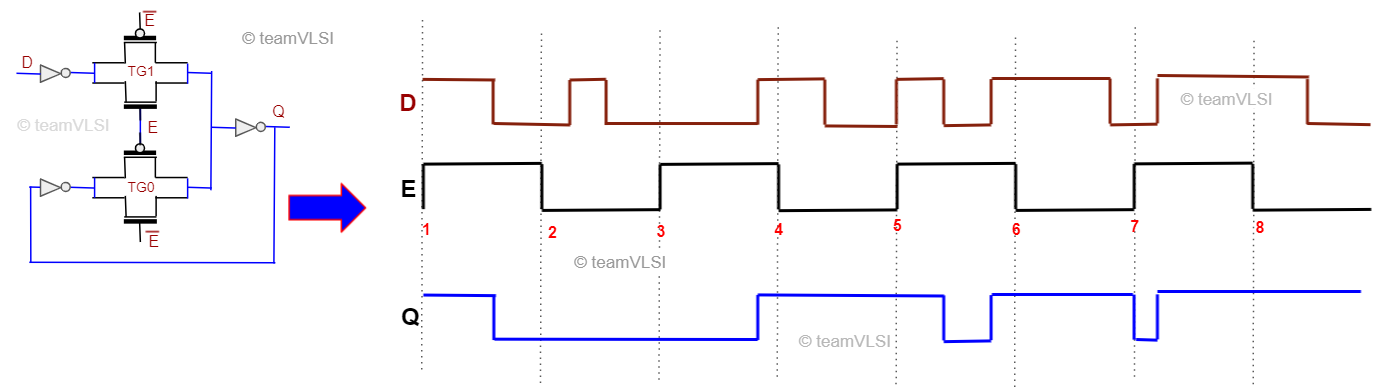
There are two transmission gates are used in a d-latch. In case of a positive level sensitive d-latch the output is feedback to the input of TGO transmission gate. Transmission gates are made of a nMOS and a pMOS as shown in above figure and it is being controlled by the enable signal E which is actually the clock signal. When the enable signal is high, the nMOS and pMOSof TG1 is in on state and at the same time, both transistors of TG0 are in off state and vice-versa happens when the enable signal is low. There is a direct path established from pin D to pin Q when the Enabe signal is high and it is called latch is in transperent state. But when enable signal goes low, TG1 gate is in off state and a feedback loop is established between Q to input of TG0 which insures that there is no change in output Q irrespective of changes in input pin D, which is termed as latch state. Figure-5 shows when the latch is transperent and when it is latched through the waveform. 

Figure-5: Working of a positive level sensitive d latch.

The working of a positive level sensitive d-latch is straight forward, it keep passing the input D to Q when its enable signal E is high and and it keep the output Q unchanged when enable signal is low. Same can be seen in figure-5, only output changes when input changes and enable signal is high.


Working of a d flip-flop

In a positive edge triggered d flip flop, there are two negative level sensitive d latch connected back to back and the second latch is having inverted enable signal as compare to first latch. This inverted enable signal to second latch makes sure that both the latch  never goes transperent or latched state simultaneously. A typical input output waveform has shown in figure-6 for better understanding.

Figure-6: Input output waveform of a positive d flip-flop

Lets consider the the case when the clock signal is low, the first latch is transperent and input D is transmitted up to QM point. But at the same time second latch will be in latched state because it gets inverted clock signal so the output Q is latched with QM. There is no chance the outupt Q will get changed in this duration.

The next moment when clock signal transits from low to high, the first latch will go from transperent mode to latched mode and second latch will go from latched mode to  transperent mode. So during the clock transition from low to high, whatever signal is sampled at QM previously gets transferred to the output Q.

The next moment when clock signal goes to high, there is not transfer of input signal D anymore and Wahtever signal previously samples at QM will be available at output Q.

The next moment when the clock signal transits from high to low, first latch will trasit from latched to transparent mode and second latch will transit from transparent to latche mode. So at this edge of clock transition there will be no change in output.

The operation of positive d flip flop can be summarized as, the output changes only at the rising clock edge and at this moment input D is trasfered to output Q and all other moment output is remain unchanged. So it is better in terms of avoid glitch as comapare to latch but more in area and more prone to process variation. For detailed operation and comparison please watch this playlist.


Thank you.


23 August

Tie Cells in Physical Design

The tie cell is a standard cell, designed specially to provide the high or low signal to the input (gate terminal) of any logic gate. The high/low signal can not be applied directly to the gate of any transistors because of some limitations of transistors, especially in the lower node. The limitation will also be discussed along with the schematic and operation of tie cells in this article. We will discuss the following sub-topics in this article.

  • Need of tie cells
  • Schematic of tie cells
  • The function of tie cells
  • Placement of tie cells


Need of tie cells:

In the lower technology node, the gate oxide under the poly gate is a very thin and the most sensitive part of the transistor. We need to take special care of this thin gate oxide while fabrication (associated issue is antenna effect) as well as in operation too. It has been observed that if the polysilicon gate connects directly to VDD or VSS for a constant high/low input signal, and in case any surge/glitch arises in the supply voltage it results in damage of sensitive gate oxide. To avoid the damages mentioned above, we avoid the direct connection from VDD or VSS to the input of any logic gates. A tie cell is used to connect the input of any logic to the VDD or VSS.

Figure-1: Need of tie cell


There are two types of tie cells.

  • Tie-high cell
  • Tie- low cell

As the name suggests, the tie-high cell's output is always high and the tie-low cell's output is always low.  


Schematic of tie cells:

The tie cell has no input pin and only one output pin. The output of the tie-high cell is always high and the output of the tie-low cell is always low and it is the glitch-free output that connects to the input of any logic gates. The schematic of tie high cell and tie-low cell is shown in the figure-2.

Figure-2: Tie-high and tie-low cells

In the tie-high cell, the drain and gate of nMOS are shorted together and connected to the gate of pMOS, and output is taken from the drain of pMOS. Whereas in the tie-low cell the drain and gate of pMOS are shorted together and connected to the gate of nMOS and output is taken from the drain of nMOS. The function of these schematics is explained in the next section.


Function of tie cells:

Both tie-high and tie-low cells have similar working. Here working of the tie-high cell is explained. A similar logic can think for tie-low cell. From figure-2 tie-high cell, the drain and gate of nMOS are shorted.

So Vg = Vd
==> Vgs = Vds
Therefore, Vds > Vgs -Vt

This shows that the nMOS will always be in the saturation region. The configuration of MOS where drain and gate are shorted is popularly known as a diode-connected transistor. And when nMOS is behaving like a diode here, the gate of pMOS is always low and so pMOS is always in on state. When pMOS is in on state its drain which is output will always be high.

Similarly, for the tie-low cell, the pMOS is always in saturation region so the gate of nMOS is always high and hence the drain of nMOS will always be at the low logic.

One more important thing is here that the sudden spike in VDD or VSS will be not propagated to the output of the tie cell.


Placement of tie cells:

Tie cells are not present in the synthesized netlist and not placed in the initial placement of the standard cells. Tie cells are inserted in the placement stage and more specifically at the final stage of placement. Where ever netlist is having any pin connected to 0 logic or 1 logic (like .A(1'b0) or .IN(1'b1), a tie cell gets inserted there. Click here to read more about the placement stage and the order where the tie cell get inserted in the placement stage.


Thank you.

21 August

Integrated Clock Gating (ICG) Cell in VLSI

 Low power ASIC design is the need of the hour, especially for hand-held electronics gadgets. In all hand-held products, the customer demands more battery life. This could be possible only if our SoC (System on Chip) inside the gadget consumes lesser power. There are various low-power design techniques that are being implemented the reduce the power consumption of application-specific integrated circuits (ASIC). The clock gating technique is one of the widely used techniques for low power design. Integrated Clock Gating (ICG) Cell is a specially designed cell that is used for clock gating techniques. In this article, we will go through the architecture, function, and placement of ICG cells.

Why ICG Cell?

ICG cell basically stops the clock propagation through it when we apply a low clock enable signal on it. This phenomenon is termed clock gating. We use the ICG cell to stop the clock signal propagation to a big group of logic cells when the group is not required to operate. This is done through a clock enable signal generated internally in the block and applied to the EN pin of the ICG cell.  We know that the total power consumption of an SoC is the sum of dynamic power and static power. The clock tree is a major contributor to dynamic power as the clock signal has maximum switching activities. The ICG cell allows to stop the clock signal propagation beyond it and it helps to reduce dynamic power consumption in the design.


The architecture of ICG Cell:

There are various ways to implement the clock gating techniques and there are many architectures of ICG cells also. Here the most common architecture is Latch-AND based ICG cell. 

Figure-1: Latch-and based ICG Cell

Prevention of glitches is one of the qualities of ICG cells. The latch-and gate based ICG cell is good on that front and that's why this architecture of clock gating circuit is used widely. There are various architectures of ICG cells but we are limiting our discussion to only this architecture in this article. 

The function of ICG Cell:

Figure-2: Waveform of ICG Cell

As shown in the above figure it provides a glitch-free clock gated output. and passed the clock single only when the enable signal is high and stop the clock propagation when enable signal is low. 


Why not only AND gate as a clock gating?

The issue with the AND gate as clock gating is, it can not provide a glitch-free output whereas a glitch-free clock wave is highly desired. 

Figure-3: AND gate as a clock gater

If there is a transition in clock enable signal when the clock signal is low, there is no effect on the gated clock. But if there is a transition in clock enable signal when the clock signal is high, there will be a glitch in the gated clock. To suppress such glitches, latch-and gate based ICG cell is preferred. 
The placement of ICG cells will be discussed in the next article.

Thank you

Important questions from Readers:

1. Why do we use Latch in ICG why not flip flop? (by Ramcharan)
Ans:
1. As we not that flip flop will capture the data only at the edge of the clock signal so any data change between one active edge to next active edge will not be captured.
2. If we use -ve edge FF the setup timing requirement for FF to ICG will be half cycle which is again difficult to meet in case of ICG placed near the sink.
Here is a waveform showing the differences in operation.


04 August

Physical Design Interview Questions for 3 years experience , Question set - 8

Code: EXIM4Y062021PD


Experience level : 3 years
    1. Brief Introduction and major projects?
    2. Tell me the most challenging part of your recent project
    3. How does the lockup latch help to fix hold violations?
    4. If we add a lockup latch, it might violate the setup? How will we fix it further?
    5. How did you fix SigEM? What are patch wires?
    6. What CTS constraints have you used?
    7. How did you fix the setup violation?
    8. Apart from setup and hold, what other checks do we perform in timing signoff?
    9. What are the PV checks?
    10. What are the sanity checks we do before starting PnR?


    11. What are the reports of synthesis we check before PnR?
    12. What are the physical cells we have used in PD and what are the uses of all those?
    13. What is the latch-up issue and how well tap cells prevent latchup?
    14. What is the endCap cell and what is the purpose of using that?
    15. What is Dcap Cell and why do we use it?
    16. What is the antenna effect?
    17. What are the ways to fix the antenna effect?
    18. How do antenna diodes help to fix the antenna violations?
    19. If we have timing criticality and we can't use antenna diodes or floating gates, How can we fix the antenna?
    20. If antenna violation is already the highest metal layer and we can use higher metal for metal hopping, how will fix the antenna?
    21. How will you fix the antenna violations on via?
    22. What is a metal cut layer?
    23. What is the crosstalk delay?
    24. What is the crosstalk noise?


Physical Design Interview Questions : Question set -7


Code: CDN5Y062021PD


Experience level: 5 Years
For Application Engineer


  1. What are the major differences between 7nm and 12/14nm technology nodes?
  2. What are the new DRC rules in the 7nm technology node?
  3. What is the via-piller?
  4. What is double patterning?
  5. How many layers have double patterning in the 7nm node?
  6. How tool performs placement steps?
  7. Why do we perform scan chain reordering?
  8. What is scan mode, why do we need that?
  9. What is ECF (Early Clock Flow) flow?
  10. What are the benefits of ECF flow?


  11. Can you explain the CTS flow?
  12. What are the low power techniques used in data and clock paths?
  13. Where does the clock-gater use?
  14. Have you built a custom clock tree?
  15. What are the constraints you have given to the clock tree?
  16. How did you solve max_trans violations in the clock path?
  17. How to provide different clock tap points in H-Tree?
  18. How many clocks were there in your block?
  19. How were they related?
  20. How did you analyze the clock domain crossing paths?
  21. What is a lock-up latch and how does it helps in hold fixing?
  22. What was the target skew in your block?
  23. What value of skew you achieved?


08 July

Placement Steps in Physical Design

Placement is a very important stage of physical design where all the standard cells get placed inside the core boundary. Overall QoR of the design greatly depends on the fact that how well placement is done. You must have noticed that the placement stage takes quite a large runtime. Actually, the tool performs various steps in a sequence to complete the placement stage. In this article, we will try to understand what are the important steps and the order in which the EDA tools perform to complete the placement stage.

Placement is the process of placing the standard cells inside the core boundary in an optimal location. The tool tries to place the standard cell in such a way that the design should have minimal congestions and the best timing. Every PnR tool provides various commands/switches so that users can optimize the design in a better way in terms of timing, congestion, area, and power as per their requirements. Based on the preferences set by the user, the tool tray to place and optimize it for better QoR. Placement does not place only the standard cells present in the synthesized netlist but also places many physical only cells and adds buffers/inverters as per the requirement to meet the timings, DRV, and foundry requirements. Here are the basic steps which the tool performs during the placement and optimization stage.


placement steps:

  1. Pre Placement
  2. Initial Placement / Course Placement / Global Placement
  3. Legalization
  4. HFNS (Hign Fanout Net Synthesis)
  5. Iteration for Congestion, Timing, DRV, and Power Optimization
  6. Multibit flop conversion
  7. Timing optimization iterations
  8. Scan-Chain Reorder
  9. Tie Cell insertion
  10. Save Design


1. Pre Placement:


Figure-1: Pre-placement step

Before starting the actual placement of the standard cells present in the synthesized netlist, we need to place various physical only cells like end-cap cells, well-tap cells, IO buffers, antenna diodes, and spare cells. A typical view after preplacement has shown in figure-1. Why these cells are required to place and how do we place them has been discussed separately in this article. Here we will focus mainly on the placement steps of standard cells present in the synthesized netlist.

2. Initial Placement / Global Placement / Course Placement 


Figure-2: Global placement before legalization

Once the pre Placement stage has been completed, We can start the placement of standard cells but before that, we have to provide all the correct placement and optimization settings that we want to be applied while the tool does the placement and optimization. These settings could be like partial placement blockage or density screen setting, bound or region creation, cell/instance padding, path_groups and effort, enabling the early clock flow (ECF) in case of innovus, enabling the extreme flow, enabling the useful skew, global congestion effort, global timing effort, power effort, Multibit flop conversion and many more.

After providing all these placement settings we can call the placement command (place_opt_design in case of innovus). The tool first does the global placement in which the tool determines the approximate location of each cell according to the timing, congestion, and multi-voltage constraints (in the case of innovus Gigaplace engine is called in this step). Any pre-placed macros will work as a placement blockage. In this stage, the tool will not check any overlap of instances. A typical figure of global placement has shown in figure-2 where you can see that the standard cells are placed in an approximate location but without legalization. 


3. Legalization

In the global placement stage, the instances are left with overlap. In this step, the tool will move the instances in nearby places to overcome the overlap. To match the proper power pins like the vdd pin of a standard cell should be on the vdd rail and vss on vss rail and for that if the fliping of instance is required tool also do the flipping. This process is called legalization. After this step, every instance should be placed in a legal location and there should be no overlaps. This step is also called refine placement.

4. HFNS (Hign Fanout Net Synthesis)

Initially, there are some nets which have very high numbers of fanout. We have a constraint of maximum fanout, so we need to distribute the sinks on nets to different drivers. The process of adding buffers and splitting the fanout is called high fanout net synthesis (HFNS). So In this step, all high fanout nets get synthesized.

5. Iteration for Congestion, Timing, DRV, and Power Optimization

In this step tool first, do an early global route and estimate the routing overflow/congestions in the design. The tool tries to initially minimize the congestion in this stage. Next, the tool starts the RC extraction to calculate the delay for setup analysis. The tool tries to minimize the setup WNS and TNS in this step. Similarly, the tool also tries to minimize the DRV and Power in this stage.

6. Multibit flop conversion

If the user enables the multi-bit flip flop conversion in the flow then the tool will first check the available multibit flops in the library. (You can read more about multi-bit cell here) The tool considers the criticality of timing associated with a single bit of flop and the user constraint set for multi-bit conversion and based on the constraints the tool converts the single-bit flop into multibit flops.

7. Timing optimization iterations

This is a long step in which the tool tries to minimize the WNS and TNS of each path group in various iterations. There are several iterations required to get a minimum WNS and TNS depending upon the effort set and initial WNS number. In case the result is not good after this stage, we can further run incremental optimization for timing. Similarly, for congetion, we can run congestion repair followed by incremental optimization to get a better result. But these additional steps will increse the run time.

8. Scan-Chain Reorder


Figure-3: Scan Chain before placement

Scan chain stitching has been done arbitrarily in synthesis. After placement and optimization, we have a location for each scan flops so it needs to be reordered for better routability. The tool performs a reordering of the scan chain in this step which is good for both timing and congestions. 

Figure-4: Scan chain after placement

Figure-5: Scan Chain after Scan chain reodrder


9. Tie Cell insertion

There are some unused inputs of logic gates in the netlist which is tied to either vdd or vss. We can not leave any inputs of the standard cell as floating, it must be tied either vdd or vss. Connecting an input of logic cell that is the gate of a transistor directly to vdd or vss is not recommended and for that, we have tie high and tie low cells in the library. (You may watch this video on tie cells for more details). So In this step tool places tie high and tie low cells which is basically a single output logic cell, and it connects the input of the logic gate which needs to connect vdd or vss respectively. 

10. Save Design

Finally, we save the database and we will use this database in the next stage, that is in the clock tree synthesis.